Monday, 28 September 2009
WRAP's last exhibition at Dungog CWA Rooms

Tuesday, 4 August 2009
WRAP closes at Parliament House NSW

We were very pleased with the numbers that attended the Parliament House NSW exhibion. If we didn't exactly fill the 100 seat auditorium twice we did manage an enthausiastic and interested audience.
It's hard to believe but after more than two years from conception our exhibition is winding to a close. There are only one more exhibition in Dungog and one talk at the Embroiderers' Guild Victoria.Friday, 10 July 2009
Exhibition and free talks at NSW Parliament House Sydney
At 11am on 17/7 and 24/7 there will be a free, one hour, illustrated talk and discussion in the Parliamentary Theatrette. This will be about the history of the wagga, the background to the exhibition and the stories collected along the way.
Tuesday, 7 July 2009
Opening at NSW Parliament House 7 July 2009
Monday, 6 July 2009
Setting up the Exhibition at NSW Parliament House

Mary and her husband, Tony deliver the works to Parliament House. The day has finally arrived we all have our visitor passes to go down to the dock to pick up the works. But Mary and Tony find us having coffee and take them up to the exhibition space.

Gina Sirabella, our curator, is undaunted by a blank space.

Starting to take shape
Are three opinions better than one?

Maybe here?

Nearly there
Sunday, 5 July 2009
Textile Artists who are inspired by the wagga
Cynthia Harvey Baker contacted us to tell us about her exhibition in Western Australian that also takes it's inspiration from the wagga. She tells us that her exhibition will be on from July 4 - 16. This exhibition includes 9 old waggas she has collected and are the inspiration for her works. It looks like a terrific display and a couple of us were tempted to go but its on at the same time as ours and we are otherwise occupied...
CWA Cotton Australia Environmental Awards 2008 winner Lynette Trupp
During our talk at Parliament House we met Lynette Trupp who won the 2008 CWA award from 33 entrants. She also gained a highly commended for another work. A great quilt made from suitably worn soft checked shirts. A most deserving winner.
Wednesday, 1 July 2009
Creative Embroidery and Cross Stitch Magazine

Thursday, 25 June 2009
Exhibition Opening and Afternoon Tea at NSW Parliament House
The official opening of the WRAP Unwrapped Exhibition will be on July 7 at 2 pm. You are also welcome to come to the afternoon tea in the Jubilee Room - contact Prue Hill on her email address on the invitation, above, to arrange payment for the afternoon tea, payment to be received by 1 July.See the post below for details about the free talks that are on July 17 and 24 at 11 am.
Thursday, 18 June 2009
WRAP Gives Talk at Quilters' Guild NSW
Wednesday, 27 May 2009
Down Under Quilts - June 2009

WRAP was very pleased to make a submission to Down Under Quilts and were even more pleased to see the four page spread with the beautiful images taken by WRAP member, Gina Sirabella. As a bonus and suprise we are mentioned on the cover! This magazine is now in stores.
Tuesday, 26 May 2009
Stories Stories Stories we love to hear them all.
Kate Farrow from the UK saw our blog and wrote to tell us about the wagga her friend from Australia had just made for her.
Nessie Pratten from the Glass House Mountains, Qld, saw an article in Textile Fibre Forum and wrote to tell us about the waggas she is still making.Late last year we exhibited our preliminary works at St Vincent’s Art Corridor and this email arrived from Valray Silverlock, Perth, … she wrote: for the second time in my life I’m feeling sorry that I did not keep my mother’s quilts that had been made of “off cuts of serge”. Her son had rung her in Perth after seeing the quilts and the stories.
The next letters and emails were a result of the article in The Senior Publication: Peter McAlingy wrote to us from Forbes and it was from him that we first learned about the term bag wagga. He tells of joining bags together in the bush with fencing wire as that was all they had.
We also had a card from Daphne Turner of Rosebud, Victoria, who also wrote of the bag wagga (opened out oat bags sewn together) in the days of horse and dray.
Dorothy Holten, Parkdale, Vic, told us of a a wagga her husband’s grand mother had made of silk knitted men’s ties – it was very heavy, like sleeping under a cement block. We were thrilled to receive this letter because Robin had been to the Quilter’s Barn at Loch and was shown their collection of old quilts which coincidentally now includes the wagga Dorothy wrote to us about.
Eileen Raphael, Parkdale Victoria, emails of a wagga for the beach house made from overcoats and scraps of dresses.Sally Donnellan ex Ganmane (near Temora) told us that her mother made a wagga from sample material for men’s suits or trousers and it is still in her possession.
Keith Brown’s Father, a tailor in the Riverina, made waggas from suiting. He says: recycling is not new.
Christine Blankenzee, did not know of the term wagga till she read about us and she is still making them.
Rosemary Horner sent us a photo of her wagga made from potato sacks. I remember standing in front of this work at the Darling Harbour show and being enthralled by it.Bruce Creenaune from Wollongong wrote to tell us that before he went to work in shearing sheds throughout Central and North West NSW his mother “sewed together,,, a mixture of heavy outer garments cut up, curtains etc and lo and behold (he) had a true blue wagga”.
Thursday, 26 February 2009
Studio visit to Anne Neal
Wednesday, 25 February 2009
Official Opening at Gilgandra 20/2/09
The official opening of the Unwrapped exhibition on Friday 20/2/09 at the Coo-ee Heritage Centre, Gilgandra was well attended. Annette gave the presentation with Robin's help at the laptop. Tanya Coxsedge and Libby Kermond-Carr and their volunteers did a magnificent job of hanging the exhibition. Christene and Diana were also at the opening.It was very pleasing to see the waggas (shown below) that been offered by various community members. The stories behind them made great reading.

Tuesday, 24 February 2009
WRAP stays at Wiber Farm, Old Gular Station.
Christene, Robin and Annette stayed in the manager's house, Wilber Farm, Gulargambone (Gular) 2828. This farm ajoins Old Gular Station where hosts Sandra and Rodney Kelly live. This large house meant we had a room each, with Christene voted to have the South Wing as we jokingly called it because of the walk in wardrobe, dressing room and large bath room complete with sunken spa bath.Robin and Annette shared the main bath room and toilet complete with visiting frogs which Christene, Annette and sometimes Rodney took turns evicting.
We learned a few things about farm life. Apparantly it's not a good idea to leave a door open at night, especially when crickets are on the hop. Luckily Christene knew how to feed the chickens, a rooster and a turkey whose numbers had been decimated in the 45 degree heat of the previous week. We were greatful to have manageable rain but kept an eye out for the water at the front gate. Because we stayed for a week the accomodation came with a country size leg of lamb and we also got to eat the eggs we collected.
On Wednesday we decided to go to Lightening Ridge (the Ridge). Along the way we met this drover who had been droving 800 head of cattle for the last 18 months taking advantage of better feed on the stock route. As there hadn't been any rain in Moree he doubted he could take them home.
His two dogs were good at tending the cattle and you can see the brown one, who always has a bottle or stick in his mouth when not working.
Monday, 26 January 2009
Exhibition closes in Temora, Opens soon in Gilgandra
Our thanks to Bill, Gay and all the other volunteers who helped with the exhibition.
The quilts are now off to Gilgandra, Opening on the 5th February through till the 26th February 2009. Annette will give the new presentation on Friday 20th February, The exhibition is now creating its own story and is collecting some interesting tales.
The city women have enjoyed giving the talk that accompanies the exhibition as it travelled around NSW. We also touch on where the wagga fit’s in the world of “make do quilts” maybe this is timely given the current climate, both economical and recycling awareness. And a few touch samples.
Christene and Robin will also be at Gilgandra to support Annette and to talk about all the quilts, the making, their journey and as usual, we would love to see any wagga’s (or the Bush quilt, or any of the other names they are known by). We’re always delighted to hear any stories; it’s just wonderful to see the person’s eyes, sparkle with memory.
Tanya is conducting a one day workshop on the 21st of February, on using recycling materials, to create a useful item. No sewing skills needed says Tanya. Contact the Coo-ee Heritage & visitors Informations centre Gilgandra. Phone: 6817 8700
Annette, Christene and Robin will spend about a week prior to the talkin the Gilgandra/Coonabarabran area soaking up more country air, discovering more wonderful things about this region of NSW. Plus taking a few pictures; marvellous these digital cameras! Robin’s father spent some time at Coonabarabran as a child.
We do hope you can catch up with some of you in Gilgandra.
Saturday, 10 January 2009
Article in The Senior (NSW) January 2009
We are truly amazed at the interest this iconic quilt has generated.
Wednesday, 19 November 2008
Textile Fibre Forum Article

Tuesday, 18 November 2008
In Ganmain showground - a haystack right out of a Monet painting. Unfortunately it was an overcast day so we couldn't photograph this one in shadow.
Flying day in Temora - another first for us
We stayed at Country Carriage B&B on Hazeldean, 22 k out of Temora near Ariah Park. This was definitely the best place we've stayed at. Rita, our host looked after us very well and we throughly enjoyed our roast dinner on Saturday night.
Gina, Robin and Annette with farm machinery.
Monday, 17 November 2008
Temora official opening, Saturday, 15 November 2008
The Mayor of Temora, Peter Spiers, opened the WRAP Unwrapped exhibition. Sunday, 16 November 2008

Wednesday, 29 October 2008
Exhibition opens at Temora Rural Museum 30/10/2008

Sunday, 26 October 2008
Cowra Guardian article on Unwrapped exhibition
http://cowra.yourguide.com.au/news/local/news/general/exhibition-unwrapped/1328254.aspx
Wednesday, 15 October 2008
Preliminary works shown at St Vincents Art Corridor

Some of the postcard and potholder size works we did...
Robin's wrap - dryfelted on an embellishing machine and the poster Gina designed.
Donna created a new work for Vinnies - shown beside her A3 work.

Gina began by reconstructing clothing before developing her shelter theme.

A3 sampling works from Prue, Dianna and Robin

Thursday, 2 October 2008
We went back to our groups inspired to make our own wagga. We gathered magazine articles and dredged up some childhood memories deciding to make our wagga of the Depression era. We soon abandoned that idea as being too impractical, deciding on this traditional one. The quilters brought their sewing machines, scissors, ironing board and fabric ... designing and making the blocks which are approx 35cm square, sewing them into strips then joining the strips together.
Most of the fabric is wool. There are three layers ending in a tweed backing.
One lady had some buttons (from her mother-in-law) left over from Broadway Tailors in Sydney. The craft ladies used these buttons and knots to "tie" the fabric layers together.
Some of our ladies have been members of the Art Group for a long time … some are over 80 and even over 90. One has a walking frame, another a walking stick, some have sight issues and some now live in Bilyara - Cowra's retirement village, but they still come to Tuesday's craft day.
Everyone sewed on buttons ...even if needles had to be threaded and hands guided.
The quilters then bound the quilt .. four of them finished off the hand sewing.
One lady from Bilyara was on holidays and her friend was concerned she would be disappointed she had missed out... as soon as Joan was back she sewed on her button.
Our aim was 1. Make a quilt in the tradition of the ‘wagga’, and 2. Create a quilt that the ladies in the groups could look at and say "I did some of that".
Hopefully we have achieved this and I know everyone was delighted to see it hanging in the Cowra Art Gallery with the impressive work from the WRAP Group. From Jenny Mason President Cowra Art Group
Extracts from stories from some of our members about "waggas"
1. We watched and helped our grandmother, who was a tailoress, make "waggas'. She would keep left over material and any old clothes such as tunics and trousers with material still usable. We would then spend afternoons cutting and placing pieces together in the size of the beds, laid out on her huge kitchen table. These were then sewn on the old treadle sewing machine, or blanket stitched together, then filled and lined. Sometimes flour bags old curtains or summer materials were used.
Every Christmas holidays our Pop who worked as a grader driver for Waugoola Shire Council and camped away in a caravan all week would bring his van home. We loved helping our grandmother clean it out renew the curtains and make a new wagga......... Sisters Judy and Robin
2. When I was growing up the lady next door had a cupboard on the back verandah where she kept old scraps, cardigans and, of all things - old boned corsets. I was about nine and remember her taking the bones out. She was making a wagga and somehow stitched it in with other pieces of all shapes and sizes. One side was covered with bleached flour bags and on the top in the place of honour was a piece of cretonne. It was as heavy as lead ..... Pam
3. My husband remembers stockmen and rabbiters working on the property had waggas made from wool sacks …… Jo
4. On the sleepout at my mother-in-law's farms at Cudal and Korawatha the black iron beds had patchwork quilts of various types of furs backed by felt. When we started talking about ‘waggas’, I thought these must have been a variation of a wagga……. Lola
5. One old shearer always came with his ‘swag’ wrapped in a kangaroo skin, and would proudly roll out his swag on the iron shearer’s hut bed where it would stay until he moved on to another shed.
Old wheat bags, too thin to hold grain anymore, were unstitched and joined together as blankets and also hung as outside walls for the boys ‘bedrooms’ on the verandah, (allowing the cat to add his warmth to the bed at night). Nothing fancy for the boys. The wheat bags were also used as make-shift but very effective raincoats, or protection for the shoulders when ‘lumping’ bags of wheat …… Nev
Monday, 15 September 2008
WRAP member, Diana Thomas opened the exhibiton at Cowra on Friday evening 13 September.
The Director of Cowra Regional Art Gallery, Brian Langer, did a fantastic job of hanging the exhibition - we are absolutely delighted to see the works in this large white space.
The exhibition will be at Cowra until October 19 October.
There are a number of great wineries in the area. The Japanese Gardens are also a must see-the cherry blossoms will be in full flower.
We were delighted to see the quilt which the local women made. We encouraged community involvement and the result is stunning.
Robin (second left) and Gina (far right) with some of the women who progressed the Cowra Quilt.

Tuesday, 5 August 2008
Catalogue now sold out (17/7/09)

Monday, 4 August 2008
Monday, 14 July 2008
At Last - our opening at Wagga
Monday, 30 June 2008
Exhibition in Wagga Wagga, ABC Radio Riverina
http://www.abc.net.au/local/audio/2008/06/24/2284329.htm
Tuesday, 20 May 2008
Wagga Stories from our Family and Friends (old and new)
Eric Crowley, was born and grew up in Barraba, Northern NSW, far away from the Murrumbidgee wheat area. He remembers going into the shearing shed to get a wool bale to make a wagga. He would fill the bale with hay, and then depending on the weather he would sleep on top of it or use it as a cover, sometimes even getting inside the bale with the hay. Because of the size of the bale there was no need to join them or even open them up.
Val's husband grew up in Western Australia, to him a wagga is a sugar bag. If two need to be joined 3 nails were used – one in the middle and one at each end.
Mirium remembers using a brick as a template to cut out the wool fabric to make a domestic wagga.
Neville of Cowra showed us how to use a wheat bag as a head covering to protect him when carrying bags of wheat.
Pete's story: remembers his father stitching potato sacks together in the shed to make blankets for the itinerant workers
Another aquaintance, Judy, told us how she use to help her mother make a wagga for her father to take on his droving trips. They were so full of dust on his return, her mother wouldn't allow it into the house, so she would burn it and make another one for his next trip.
From the Powerhouse collection of quilts, comes the story, a new bride, not wanting her new husand to take her lovely new blankets on a fishing trip, made him a wagga. This became one of his treasured possessions.
In Scotland - the just add more coats on top of the bed... no stitching required.
Bill from Temora, his father carried one to war...
Another tale we heard, the hessian bags were chucked into the dam for several weeks to soften.
Judy, when asked about a wagga, said that her husband used the family hand me down wagga on the floor in the house while he was restoring his motor bike!
Makesme wonder how many dogs got beds made from disused waggas.
Tales told around a Friday sing-a-long at Junee recently, Remembers helping the mother spread the clothes out over the curtin material for the inside of the wagga.
Speaking with a women in Yarrawong. She told us , her family found an old wagga, under the matress of a single bed in a spare room of her mothers house, been there for years, no one knew about it
Annette, while on a trip, was searchong for a wagga. She found one in the Salvo's shop at Wagga, but it looks like it was only a few years old.
Another friend, told us she made a quilt when she was first married (that on reflection, probably was a wagga) and when they separated years later, he took the wagga.
Lots of people tell us about the fur skins rugs they have, but unfortunately, they don't fit into this catagory. but they are interesting stories... often made from kangaroo skins, rabbit and fox skins. even a tasmanian devil skin one in the Tasmanian museum and a platypus skin one in the Powerhouse collection.
At an exhibition we read of a wagga in the Sunraysia district of Victoria where the batting was hessian, presumably from the drying racks for the dried fruit
Invitation to Opening, Wagga Wagga
"Unwrapped"
Saturday afternoon
June 28 2008
Museum of the Riverina
Botanic Gardens site
Wagga Wagga
Artist's talk by several members of the WRAP group
Please contact us by 14/6/08
wrap_wagga@hotmail.com
02 95972982 (Annette)
Children's Workshop at Wagga - Crow Hand Puppet
Where: Museum of the Riverina Botanic Gardens site
When: Wed 9 July 10am-2pm
Information: $33 per child, includes a workshop kit, BYO lunch
Bookings: Phone 6925 2934 (the Museum).
Friday, 21 March 2008
Preview our Exhibition
Diana

Diana’s quilts explore the emotional tug inherent in waggas that contain reused clothing - memories of dead loved ones, childhood and past fashions.
Prue
Prue has created panoramas of colour – using up the off cuts accumulated during many years of weaving her own fabrics – off cuts that remind her of the clothes she has worn and the people that have received her weaving as gifts .Mary

Mary has used commercial wool suiting samples from the fabric stashes of friends and family, including her husband’s trousers! to create a traditional quilt with a modern twist.
Donna

Donna has responded to the countryside where the wagga originated, her quilts reflect the wheat fields of the Mallee, where she grew up.
Robin
Shelter is also the fundamental idea behind Robin’s wonderful wagga wrap. Made from Harris Tweed jackets purchased for $5 from Op Shops – a flour bag quilt comes with it for use as a mattress should the need arise – reuse, warmth, comfort and shelter. Robin has also produced a quilt made from blanket samples which have been appliquéd and embroidered with the help of an embellishing machine.Annette
Annette has investigated the towns where our quilts will be exhibited. Her wall hangings, based on the grid patterns of the map of each town, resonate with the history and connection in the locations of railway station, flour mill and gallery.
Catherine

Catherine has developed a fabric sampler book – a result of her research and thoughts about the role of text and the wagga.
Gina
Gina’s ingenious re-use of old umbrella frames, is firmly based in the idea of recycling and shelter, yet she has projected those ideas into a future era - as a comment on climate change. CHRISTENE
Christene’s quilt is constructed from denim jeans purchased for $3 a pair at Op Shops, seams unpicked and taken apart, and recreated in a quilt of tactile pleasure, with pockets for holding all those things that you may need in bed!!! Christene was thinking of matchbox cars!
Thursday, 20 March 2008
Progress

This talk was expanded, and delivered by Robin with Annette's PowerPoint presentation at The Embroiderers' Guild NSW in March. Our research textiles were on display.
The preview of our 'Unwrapped' travelling exhibition that was shown will be on our blog soon.
We also did another road trip late February, to Cowra and Wagga.
In Cowra we met with several women who are interested in finding their own wagga rug history.
We were fortunate to see some fine examples of wagga's belonging to the Cowra women.
Neville explained and demonstrated the sewing of wheat sacks, and their usefulness in creating a head covering.
Met with Sarah and Fay from Embroiderers Group, Wagga.
Fay has designed a wonderful Wagga Crow Puppet, that is suitable for children, which we hope will be taught during the exhibitions.
Exhibition: Change of Venue
Thursday, 15 November 2007
A GREAT DAY AT THE POWERHOUSE MUSEUM
A volunteer and her able assitant patiently waited whilst we oohed and ahhed over the waggas they produced. It would have seemed odd to anyone but those present to hears the queries and comments made by us.
In many cases there was little information other than the provence of these waggas.
- One had been lovingly made by a new bride in the 1930's for her husband to take camping - and so protect her own new blankets. We marvelled at the blues which seemed so bright. The archive notations suggested that the husband was very pleased with his gitft and told all his wife had made it for him. Click here for a look.
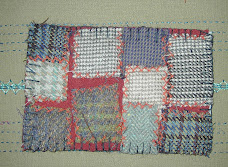
- Whilst none of the waggas had a flour bag as backing or internal lining, two had been made with hession. One in particular facinated all of us - tailors samples, with no attempt to create a pattern, had been laid on hessionin the order they may have been in the sample book and oversewn without regard to neatess and straight lines - it was cause for a few comments. Raw edges were definite the de rigour of Miss .............. who created this little item. Click here for a look
- Who but us could be excited by the sight of old darned socks and daggy old clothing? We an inside of a wagga was produced were intrigued to see old clothing stuffed and tacked higgledy piggledy into a lining. Why didn't the maker square off and flatten the stuffing? The conclusion: Why would you bother when you were looking for bulk, warmth and were going to cover it.
Tuesday, 13 November 2007
Exhibition at Rogue Gallery, Long Jetty
Those of us that were there enjoyed sandwiches and a glass of something as well as a couple of very short speaches.
Big thank yous all the way round to David & Phillip of Frame 'n Art (to which Rogue Gallery is attached) who effectively sponsored the exhibition "Mixed Threads". Guys, without you we wouldn't have done it. It has been great exposure for WRAP and our joint exhibitors Filament and Stitches Plus.
I will add some photo links shortly.
Wednesday, 31 October 2007
Wrap at Emboiderers' Guild 50th Anniversary Exhibition
"Audiences enjoyed a wide range of textile artwork from various groups at the recent exhibition held at the Southee Complex (Olympic Park) for the Embroiderer's Guild's 50th Anniversary. One of those groups happened to be the Wrap group which is exploring the history and techniques of waggas (old aussie scrap quilts).
The range of quirky and unique techniques of each piece intrigued many visitors. Some of the techniques from these beautiful works ranged from embroidery on wool, buttons and zippers sewn on scrap and old babies clothes stitched into a piece.
All and all it was a successful exhibition and a great place to show off our pieces."
I am glad she though it was successful ... her comments are few and I am sure she thinks her Mum's got rocks in head but is too polite to say .
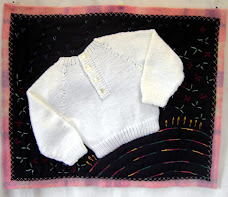
The display also included some play pieces we had worked in anticipation of the exhibitions "Baby wagga "on the left is a taste. Click here to see more.
Saturday, 15 September 2007
What makes a quilt?
Saturday, 1 September 2007
"Waggas Unwrapped"
Our exhibition name was chosen - Waggas Unwrapped - and exhibition arrangements are currently being finalised. Rather than put the mozz on it we won't say the places and times until it is all finalised. Needless to say we are all very excited.
To add to our day we had the oppotunity to see and enjoy two old quilts first hand.
The first was a wagga from Suzaannah Place, the Historic Houses Trust museum in Sydney. It is made of small pieces of tailors’ samples sewn together with twill tape which was originally dark purple with some pieces of dark green and fewer of black. The original backing was a yellow curtain fabric. This blanket has been widened by adding joined rectangles of tailors’ samples to both sides. On one side the sample addition was folded over in half neatly but the other side didn’t have enough samples so a cotton sheet was added to cover the deficiency and the original yellow backing. The tape has faded but the samples are muted blues, greys and browns to give a very contemporary, minimalist look.
The second quilt was bought in Atlanta Georgia a number of years ago by a collector who lent it to our group for the day. It has opened seed bags for backing. The front is an “around the world” pieced quilt. We enjoyed discovering how the maker worked by examining the block progression.
Everyone shared their A3 sized waggas which will form our display at the Embroiderer's Guild 50th celebrations in October this year: some were finished and others in progress (either in the fabric selection phase or in the head).
Sunday, 29 July 2007
on flour bags, quilts and exhibiting
Tuesday, 17 July 2007
power house museum
Saturday, 14 July 2007
isa's quilt

New to Australia from the USA on a teacher exchange program in the early 70's Isa and her husband were told the climate was like California. They packed accordingly... and were posted to Lithgow in mid winter.
Isa searched for extra anything to keep them warm and found this wagga in a local op shop. It is only in more recent times Ina has learnt of the history of waggas and the make do element that accompanies them.
For more pictures of Isa's quilt click here
off and running
Intrepid members of the goup have already traversed the ground between Sydney, Cowra, Wagga Wagga and Temora in search of the wagga quilt story. Laden with stories and empty flour bags, to the amusement of friends and family, the travellers have returned to Sydney. Heavens's knows how, mobile phone conversations lead the writer of this post to belive that they were lost "on the road to the snow" and would never find their way back. I thought ast least they would freeze - stuck in their small car with all those waggas in the making (the four bags of course - all 60 of them !).